Digital Marketing Ideas to Reach Your Ideal Dental Patients
Modern consumers are always online. As a result, it is important for dental practice owners and marketers to keep up with new trends in user behaviors that will impact their marketing strategy.
The ever-changing platforms and channels of the digital world can be challenging for growing practices. From small businesses to growing businesses, keeping up with the digital marketing world can feel like a full-time job.
Here are some tips to sift through the plethora of web-based marketing solutions and create a streamlined and effective digital marketing strategy for your brand.
Marketing Strategy vs. Digital Marketing Strategy
In today’s high-tech world, the terms marketing strategy and digital marketing strategy may seem interchangeable. So let’s examine the differences between the two.
A marketing strategy is the overall game plan that helps businesses achieve their business goals through specific marketing or revenue-based initiatives. A digital marketing strategy utilizes select online marketing channels to attain specific digital goals.
A digital marketing campaign refers to the specific actions you take as a part of your digital strategy to achieve a particular outcome.
Understanding Your Audience Is Key
Who are you marketing to? To create a smart digital marketing strategy, you need in-depth knowledge of your ideal patient. The best digital marketing strategies arise from well-researched buyer personas that represent your ideal patients.
You can create buyer personas by researching and analyzing your company’s target audience.
Perform a Content Audit and Plan Your Owned Media Campaigns
Owned media is the concept at the core of digital marketing. The more owned media channels your practice has the larger your digital footprint. Any content that your company owns and controls is owned media, including:
blog posts
service descriptions
social media posts
Evaluate your existing content regularly, and add fresh content to keep followers engaged and attract more website visitors.
Effective content creation ensures a strong online presence for your dental office. Even better, search-engine-optimized (SEO) content boosts your search and organic traffic.
Mobile-Friendly Content
Consumer usage of mobile devices is at an all-time high and continues to grow. Therefore, incorporating a mobile-friendly website into your marketing plan should be a significant consideration in a smart marketing campaign.
Ensure that your website loads quickly and is easy to use on a phone or tablet device. Today, Google boosts sites that perform well on mobile phones as most consumers today complete their local searches via their phones.
Digital Marketing
As a dental business owner, you’ll want to focus on marketing strategies that provide the best value for your business and most relevance for your industry.
Start by creating a digital marketing budget for your campaign. You will need to research digital pricing to get a sense of what your type and size of business requires—research digital marketing costs to build a realistic budget for your practice.
Once you launch your campaign, take advantage of Google’s free resources such as Google Analytics or Google Ads to track and measure the results.
Search engine optimization is perhaps the most important digital marketing enterprise in use. SEO aims to direct the target audience for your website, generating more leads and a higher conversion rate. You can achieve this by using specific phrases and keywords that relate to your services.
An effective SEO strategy brings more traffic to your website from members of your target market. These are the users who are actively looking for your dental services. As a local business, it’s important to attract leads from your local area. SEO is great because, when done correctly, it’s targeted to your service areas.
Other Digital Marketing Strategies
Content marketing involves engaging and connecting with users by creating content that is relevant and informative:
video content
infographics
blog posts
and more
Guest posts, also known as guest blogging, are when you contribute a blog post to another person’s site to increase your exposure and authority, as well as to add links to your own website. This type of content should not be sales-related but should provide value to users as an informative free resource.
Well-executed, relevant content is one of the most effective online marketing strategies to increase sales, traffic, and conversion rates. In addition, an effective content marketing strategy should optimize your content for high rankings with search engines, increasing your prominence in Google search results.
Email marketing focuses on retaining existing patients and gaining new patients by building brand awareness and increasing sales via email. Email marketing is similar to content marketing in that the focus is on providing valuable information to subscribers. As a result, email marketing generates about 50% more sales than other digital marketing tactics.
Social media marketing is probably the most popular marketing strategy for dental practices since it’s easy to get started and fairly easy to maintain. Social media marketing campaigns can utilize multiple platforms based on the preferences of the audience.
Social media marketing may also employ online advertising platforms. For example, Facebook Ads is a paid advertising service where you can create ad campaigns with targeted goals and objectives. You write your copy in the voice of your business to help reach its intended audience. The most popular social media platforms are Facebook, Instagram, Twitter, LinkedIn, and Pinterest.
You may have heard of “Social Media Stories,” which started on Facebook and have become so popular that they’ve extended to Instagram. Facebook Stories are images and videos that appear independent of your regular feed and disappear after 24 hours. The ephemeral format drives followers to engage with the story before it disappears from their feed.
You can utilize video marketing across multiple digital and social media channels. Its purpose is to market and promote your business and increase viewer engagement.
Lastly, influencer marketing is a relatively new type of word-of-mouth marketing by individuals with a large social following. Influencers have established a strong trust from their following and gain a reputation as experts within their niche.
Let Us Bring Your Marketing Ideas to Life
Our marketing firm is a full-service marketing agency focused on the dental industry.
We pride ourselves in building collaborative client relationships on mutual respect and trust. Our experience, knowledge, and expertise make us one of the most sought-after agencies for dentists nationwide.
How to Calculate Profit Margin for Your Dental Practice | Step-by-Step Guide
Understanding the financial health of your dental practice is essential for effective dental practice financial management. One of the key metrics to evaluate is the dental practice profit margin, which indicates how much profit your practice retains for every dollar of revenue generated. In this guide, we will walk you through a detailed, step-by-step process for calculating profit margin, complete with formulas and practical examples.
Understanding Dental Practice Financial Terms
Revenue: Total income generated from dental services provided to patients.
Costs: Total expenses incurred in running your practice, categorized into fixed and variable costs.
Profit: Difference between your total revenue and total costs.
Gathering Financial Data for Your Dental Practice
Identifying Fixed and Variable Costs
To accurately calculate your dental practice profitability, collect relevant financial data for a specific period (monthly, quarterly, or annually). This includes:
Total Revenue: Income from all dental services.
Fixed Costs: Expenses that remain constant regardless of service levels, such as rent, salaries, and insurance.
Variable Costs: Expenses that fluctuate based on service levels, including supplies, lab fees, and utilities.
Calculating Total Costs in Your Dental Practice
Use the following formula to calculate total costs:
Total Costs = Fixed Costs + Variable Costs
Example:
If your fixed costs are $200,000 and your variable costs are $150,000:
Total Costs = $200,000 + $150,000 = $350,000
Determining Your Dental Practice Profit
Calculate your profit using this formula:
Profit = Total Revenue – Total Costs
Example:
If your total revenue is $500,000:
Profit = $500,000 – $350,000 = $150,000
Calculating Your Dental Practice Profit Margin
Determine your profit margin using this formula:
Profit Margin = (Profit / Total Revenue) × 100
Example:
Profit Margin = ($150,000 / $500,000) × 100 = 30%
Practical Example of Profit Margin Calculation
Total Revenue: $500,000
Fixed Costs: $200,000
Variable Costs: $150,000
Total Costs: $200,000 + $150,000 = $350,000
Profit: $500,000 – $350,000 = $150,000
Profit Margin: ($150,000 / $500,000) × 100 = 30%
Analyzing Your Dental Practice Profit Margin Results
A profit margin of 30% indicates your practice retains $0.30 for every dollar earned after covering costs. Regularly calculating profit margins helps identify trends and areas for improvement, enhancing your dental practice profitability.
Additional Tips for Financial Management
Automation: Use accounting software to automate calculations and maintain accurate financial records.
Regular Reviews: Regularly review your profit margins to inform decisions about pricing, cost management, and overall practice strategy.
Conclusion: Enhancing Your Dental Practice Profitability
The smile on a patient’s face after a dental cleaning isn’t just about aesthetics—it represents health, confidence, and quality of life. Yet across America, that smile is becoming harder to maintain as a growing shortage of dental hygienists threatens access to essential oral healthcare. This invisible crisis is reshaping the dental industry and impacting millions of Americans who rely on these skilled professionals for preventive care.
In this comprehensive overview, we’ll examine the current state of the dental hygienist workforce in the United States, analyze the statistics behind this concerning shortage, and explore the far-reaching implications for dental practices, patients, and public health.
The Current Landscape: America’s Dental Hygienist Workforce
The dental hygienist profession stands at a critical crossroads in 2025. These essential healthcare providers—who perform cleanings, take X-rays, screen for oral diseases, and educate patients on proper oral hygiene—are becoming increasingly scarce across the country.
As of early 2025, approximately 7,085 designated dental professional shortage areas exist across the United States, according to data from Becker’s Dental. These shortage areas represent communities where access to dental care is severely limited, affecting millions of Americans who may go without essential preventive services.
The shortage isn’t merely a statistical concern—it represents a fundamental shift in the dental care ecosystem that has been building for years and was dramatically accelerated by the COVID-19 pandemic. While demand for dental hygienists continues to grow, the supply of these professionals has not kept pace, creating a widening gap that threatens the oral health of communities nationwide.
By the Numbers: Key Statistics Revealing the Crisis
1. Workforce Exodus and Burnout
Perhaps most alarming is the potential for further deterioration of the workforce. The American Dental Hygienists’ Association (ADHA) reports that 31.4% of dental hygienists are actively considering leaving the profession. This staggering figure represents nearly one-third of the current workforce contemplating an exit.
The primary drivers behind this potential exodus include:
Professional burnout from increased workloads
Pandemic-related stress and safety concerns
Compensation issues that haven’t kept pace with responsibilities
Work-life balance challenges in a demanding field
2. Recruitment Challenges and Employment Patterns
The labor market for dental hygienists has tightened significantly in recent years. According to ADA News, 33.9% of dentists were actively recruiting dental hygienists in late 2024, reflecting the high demand for these professionals. Many practices report positions remaining unfilled for months, with some offering signing bonuses and enhanced benefits packages to attract candidates.
This recruitment challenge creates a cycle that further strains the system:
The Health Policy Institute estimates that labor shortages have resulted in an 11% reduction in dental practice capacity nationwide. This significant decrease means fewer patients receiving care, longer wait times for appointments, and potential deterioration in oral health outcomes as preventive services are delayed.
For many practices, this reduced capacity translates to:
Fewer available appointment slots
Increased pressure on remaining staff
Potential quality concerns as teams are stretched thin
Financial implications for practice sustainability
4. Demographic Shifts and Retirement Wave
Compounding the current shortage is a looming demographic challenge. According to the Bureau of Labor Statistics, a significant portion of the dental hygienist workforce is approaching retirement age. This “silver tsunami” threatens to remove experienced professionals from the field faster than they can be replaced by new graduates.
The aging of the workforce presents unique challenges:
Loss of institutional knowledge and mentorship
Reduced part-time workforce options
Geographic imbalances as retirees leave certain regions
Training gaps for specialized skills and technologies
Root Causes: Understanding the Factors Behind the Shortage
The dental hygienist shortage didn’t develop overnight. Multiple interconnected factors have contributed to the current crisis:
1. Pandemic Aftershocks
The COVID-19 pandemic fundamentally altered the dental industry. Many hygienists left the profession during mandatory shutdowns, while others reconsidered their careers due to concerns about aerosol-generating procedures and infection risks. Despite improved safety protocols, many have not returned to the field.
2. Educational Pipeline Constraints
While interest in dental hygiene careers remains strong, educational programs face capacity limitations. Clinical training requirements, faculty shortages, and limited clinical rotation sites constrain the number of new graduates entering the workforce annually.
3. Evolving Practice Models
The business of dentistry is changing, with corporate dental groups acquiring independent practices and implementing new operational models. These shifts have altered working conditions for many hygienists, sometimes creating environments that prioritize productivity over professional autonomy.
4. Geographic Maldistribution
The shortage isn’t uniform across the country. Rural areas and underserved urban communities face particularly severe shortages, as hygienists tend to concentrate in metropolitan regions with higher compensation and more diverse practice opportunities.
Implications for Public Health and Patient Care
The dental hygienist shortage extends far beyond the dental office, with significant implications for public health:
Preventive Care Gap
Dental hygienists are the primary providers of preventive dental services. Their shortage means fewer patients receive regular cleanings, fluoride treatments, sealants, and early detection screenings—interventions that prevent more serious oral health issues.
Systemic Health Connections
Research continues to strengthen our understanding of the connections between oral health and systemic conditions like heart disease, diabetes, and pregnancy complications. Reduced access to dental hygiene services may contribute to poorer overall health outcomes.
Health Equity Concerns
The shortage disproportionately affects vulnerable populations, including low-income communities, rural residents, elderly individuals, and those with special healthcare needs—groups that already face barriers to dental care access.
Promising Developments and Future Outlook
Despite the challenges, there are encouraging signs and initiatives aimed at addressing the dental hygienist shortage:
1. Expanded Scope of Practice
Several states have expanded the scope of practice for dental hygienists, allowing them to perform more procedures with less direct supervision. These changes maximize the impact of the existing workforce while creating more fulfilling career paths.
2. Educational Innovation
Dental hygiene programs are implementing innovative approaches to increase capacity, including:
Accelerated degree options
Distance learning components
Simulation technology to enhance clinical training
Partnerships with dental practices for expanded clinical rotations
3. Policy Initiatives
According to ADA News, new policies are being implemented to empower states to alleviate the dental workforce shortage. These include loan forgiveness programs, tax incentives for practicing in shortage areas, and grants for educational institutions to expand training capacity.
4. Technology Integration
Digital dentistry, telehealth applications, and AI-assisted diagnostics may help extend the reach of the existing workforce, allowing hygienists to focus on the most complex aspects of patient care while technology handles routine tasks.
Conclusion: A Call to Action
The dental hygienist shortage represents one of the most significant challenges facing oral healthcare in America today. Addressing this complex issue requires a multifaceted approach involving educational institutions, professional associations, policymakers, and dental practices working in concert.
For patients, the message is clear: preventive dental care remains essential, and establishing a relationship with a dental provider should be a priority. For those considering careers in healthcare, dental hygiene offers meaningful work with significant growth potential and the opportunity to make a real difference in community health.
As we navigate this challenging landscape, one thing remains certain: dental hygienists are irreplaceable components of the healthcare system, providing services that go far beyond clean teeth—they are guardians of the gateway to overall health and wellbeing.
The smile on a patient’s face after a dental cleaning isn’t just about aesthetics—it’s about health, confidence, and quality of life. Ensuring that smile remains accessible to all Americans will require our collective commitment to supporting and expanding the dental hygienist workforce for generations to come.
Discover the powerful impact of targeted dental marketing with KickStart Dental Marketing’s latest success story. In this detailed case study, we dive into how we partnered with an established dental practice to not only improve their online presence but significantly increase their patient numbers and net income.
Speaker 1 (00:00):
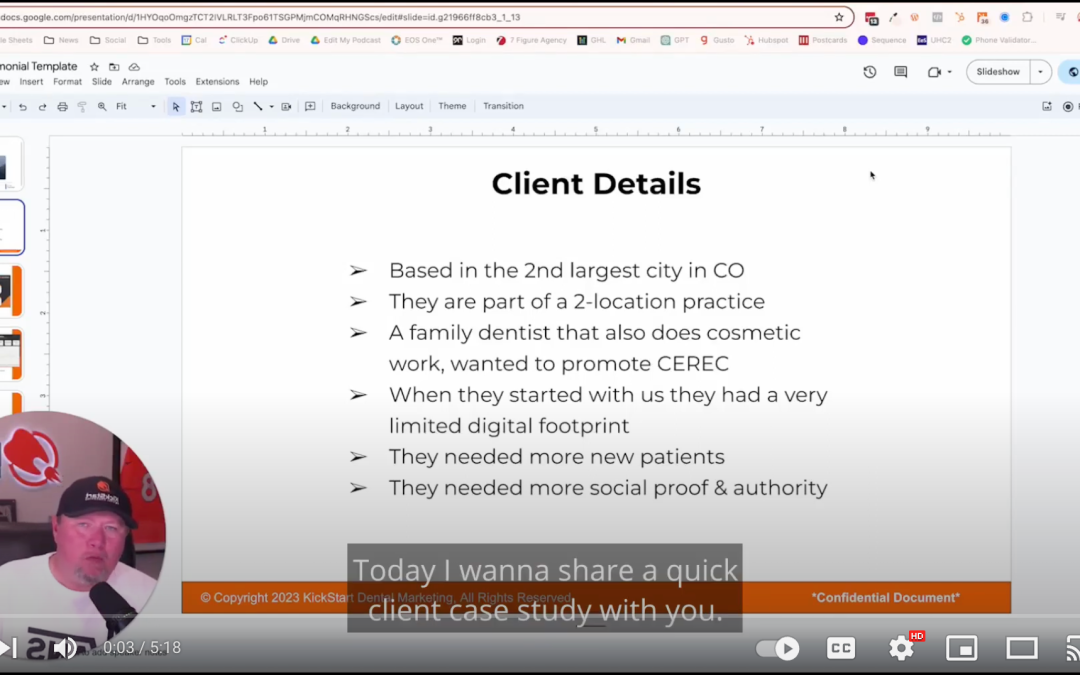
Hey everybody, it’s Chris again with Kickstart Dental Marketing. Today I want to share a quick client case study with you. Now, I can’t name the client because they don’t want to be named, but I want to go over their actual results with you and just kind of show you what’s capable for your practice out there. So this particular client is based in the second largest city in Colorado. So it’s a very competitive market. They actually have two locations that we help manage for them. They’re a family dentist. They do some cosmetic, and they really wanted to promote CEREC more than anything. And then when they started with us, they had a very limited footprint. They had a lot of ambitious goals, but they didn’t have much of a digital footprint. They didn’t have much visibility, no real online reviews, things like that. So that’s kind of where we started from.
(00:52):
They obviously needed more new patients, but the thing about them is they just didn’t want any patient. Okay? So they are a fee for service office. So they only do cash business basically, and they wanted that right kind of quality new patient and they really needed to beef up their social proof, kind of their authority, get more reviews and promote more reviews. So that’s kind of where we started with this client. So I want to show you just a quick slide here. This is a screenshot from our actual internal reporting system. We provide our clients with a 24 7 marketing dashboard that they can log into at any time and see what’s going on. So this is just one screenshot from that, but you can see how they did. Basically this was for January of 2024. They spent a total of $2,496 for that month between paid ads, our fees, all of that fun stuff.
(01:48):
They got 70 verified leads. And when I say verified leads, we have a team of people that actually listens to every call that comes in. They look at every text that’s sent in and any form that’s filled out and they verify that it’s an actually qualified new patient for this practice. They’re looking to make sure that their fee for service, right, they’re not Medicaid or something like that, that they want a service that our client provides. That’s what we really consider and count as verified leads. So 70 verified leads, that’s not just total phone calls. That breaks down to about $36 per verified lead, which is in this industry really good. We have with them a closed goal of 50%. So basically if we send 70 verified leads to them, the goal is to get 35 of those scheduled. We change that goal based on our practice.
(02:43):
Some of our clients do 30%, some do a little bit higher. It just kind of depends where you’re comfortable. And then we have a calculation of basically, all right, well if we brought you 70 and you did get 35 to schedule, that should be worth about 17 $500 to your practice just for that month. Now, those are just kind of numbers and these aren’t actuals, but the verified leads, the money spent, the cost per verified lead, that’s all good solid information, and that’s not really counting what the lifetime value. So if they did get 35 new patients in the door, let’s say 30 of those stay long-term, how much revenue is that worth year over year, month over month? So a really good story for them. And this next slide kind of shows the last three months, November, December into January. In November they did 73 December, slowed down a little as it does a little bit in dentistry for new patients, 55, and then January back up to 70.
(03:49):
This chart over here shows their website traffic from back in April of 2023, going all the way up from 500 or so visitors to 2000 visitors. So a lot of the work that we did with our SEO campaigns and some paid marketing campaigns as well has really not only helped get in patients and traffic, but the right kind of patients and traffic as well. So we’ve been able to really tweak it to dial it in, if you will, to the right audience. So we built them a great website. We’re doing SEO, we’re doing Google Maps optimization. We have been able to grow their online reviews tremendously as well, which helps with the SEO, and it just helps with branding and it helps with that social proof. We are doing some paid ads for them right now on Google and Facebook. And then this pre precision tracking software that we have that I’ve showed you some screenshots from, has really gone a long way as well. So anyway, I just wanted to share with this with you and just give you some inspiration of if you’re a struggling practice or you’re a little stagnant, this is the kind of stuff that you can expect and you should be able to really work towards. Now, if you need some help with this shameless plug, we’re here for you. Kickstart Dental Marketing. Our phone number’s (303) 872-6067, or you can go right to the website and you actually schedule a one-on-one strategy session with me, and that’s at kickstart dental.com. Thanks. Talk to you soon.
"We started working with Kick Start in Q2 of this year, and the dramatic results we saw from their team left us floored. With the right strategy, our rankings improved instantly! Their professionalism, transparency, and ability to stay on brand has been refreshing. Additionally, the monthly reporting meeting is really insightful. The Dentistry Collective highly recommends Kick Start for all your digital marketing needs! Wonderful team!"





 The smile on a patient’s face after a dental cleaning isn’t just about aesthetics—it represents health, confidence, and quality of life. Yet across America, that smile is becoming harder to maintain as a growing shortage of dental hygienists threatens access to essential oral healthcare. This invisible crisis is reshaping the dental industry and impacting millions of Americans who rely on these skilled professionals for preventive care.